
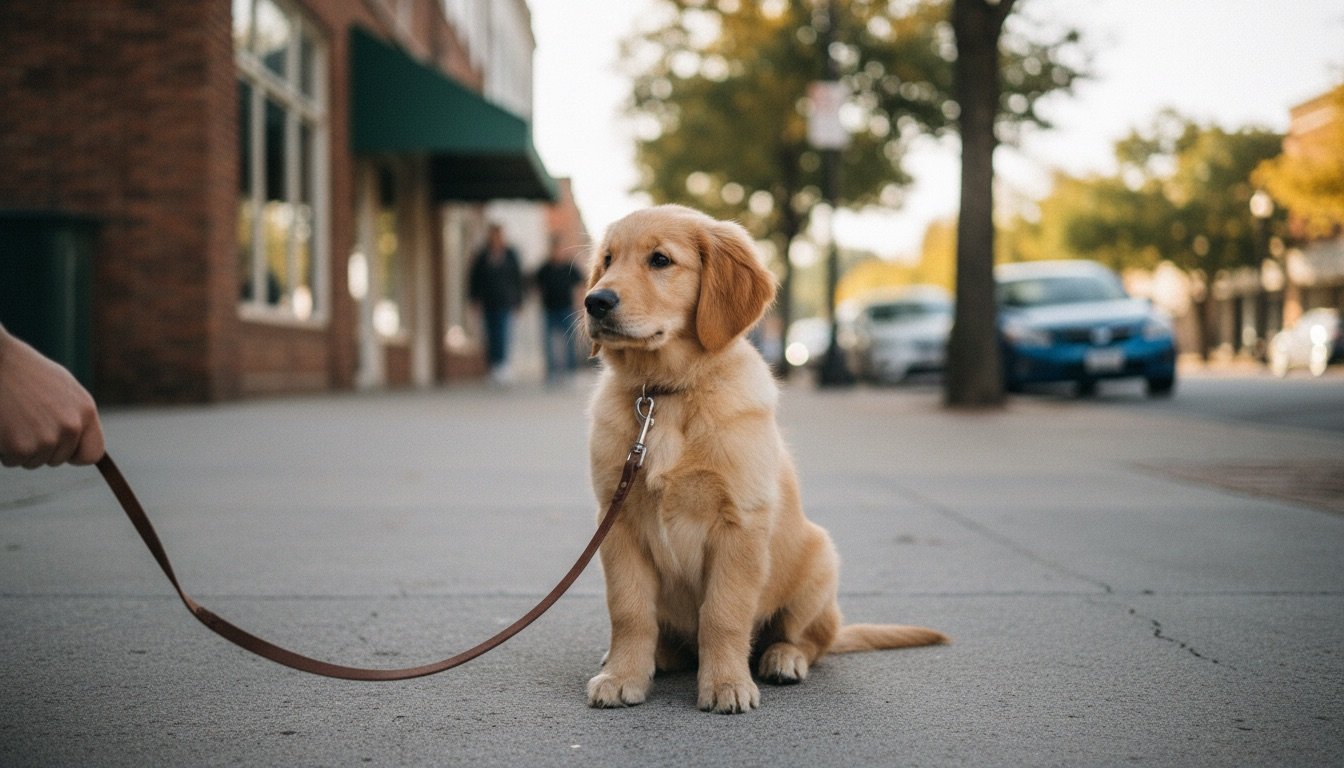
Socialisation is the most misunderstood word in dog ownership. Most people hear it and picture a puppy meeting lots of other dogs. That is not what it means, and chasing it that way does real harm.
Socialisation means a puppy learning that the ordinary world is unremarkable. Not exciting, not frightening. Unremarkable. The goal is a dog that notices a skateboard and goes back to sniffing the grass.
The window, and why it is a deadline
There is a period, roughly three to sixteen weeks, when a puppy’s brain accepts new things as normal by default. Inside that window a novel experience is filed as ordinary. Outside it, a novel experience is filed as suspicious until proven otherwise, and undoing that takes months of careful work.
The first half of that window happens at the breeder’s. That is why how a litter is raised matters more than almost anything you will do later, and why a puppy raised in a quiet outbuilding starts life behind one raised in a kitchen.
The second half is yours, and it overlaps almost exactly with the period before the vaccination course finishes. That conflict is real and it is dealt with below.
The list that actually matters
Not other dogs. Aim for calm, brief, positive exposure to as much of this as you can manage:
People who do not look like you. Different ages, heights, voices and skin tones. Hats, hoods, sunglasses, beards, high visibility jackets, uniforms, walking sticks, wheelchairs, pushchairs, umbrellas.
Surfaces. Tile, carpet, gravel, grass, metal grating, wet ground, a wobbly board, stairs. Surfaces are the most commonly skipped item on any socialisation list and the most common source of an adult dog that will not walk somewhere.
Sounds. Traffic, sirens, a vacuum, a hairdryer, a doorbell, a smoke alarm, thunder, fireworks, a dropped pan, children playing at a distance.
Handling. Feet held, ears looked in, mouth opened, tail touched, nails clipped, brushed all over, lifted. Do this daily. It is what makes a vet visit boring for the next fourteen years.
Being alone. Genuinely a socialisation item. Five minutes on the other side of a door, then ten, then twenty, from the first week. A puppy that is never alone in month one is a dog with separation problems in month six.
Vehicles. Short car journeys that end somewhere pleasant, so the car does not only ever mean the vet.
Doing it before the vaccinations are finished
The disease risk is real and so is the behavioural risk, and behavioural problems put more dogs in shelters than infectious disease does. The answer is not to choose one, it is to socialise in ways that carry almost no disease risk.
- Carry the puppy. In your arms, a puppy meets a car park, a bus stop, a queue, a busy pavement, without touching the ground.
- Sit in a parked car with the windows down. Traffic, sirens, dogs at a distance, no ground contact.
- Invite people to your house rather than taking the puppy to unknown places.
- Use gardens belonging to people whose dogs you know are vaccinated and healthy.
- Find a puppy class that requires proof of vaccination from every attendee and cleans its floor.
Avoid public parks, pet shop floors and the grass outside a veterinary practice until your vet says otherwise.
How to do it so it works
Watch the puppy, not the list. The aim is a puppy that notices something and carries on. A puppy that is frozen, tucked, panting, licking its lips or trying to leave is not being socialised, it is being frightened, and each of those experiences makes the next one worse.
Distance is the dial. If something is too much, do not push through it. Move further away until the puppy can watch it calmly, and let it choose to approach. Then stop while it is still going well.
Short and often beats long and rare. Five minutes of calm exposure, five times a week, beats an overwhelming Saturday afternoon.
Never force an approach. Dragging a puppy towards the thing it is worried about teaches it that being worried does not work, which is the opposite of the lesson.
Let them sleep. A puppy of this age needs an enormous amount of sleep and an over-tired puppy learns nothing. One outing a day is plenty.
The mistake that undoes all of it
Letting every dog you pass say hello.
A puppy that greets every dog it sees learns that dogs on leads are always available, and that is how you get a fifteen month old adolescent that screams and lunges when it cannot reach one. Worse, one bad encounter with an intolerant adult dog in this window can leave a lasting fear.
Aim for a small number of good encounters with known, calm, vaccinated adult dogs, and teach your puppy to watch other dogs go past without interacting. That is the more useful skill and almost nobody teaches it.
After sixteen weeks
A workable first four weeks
People do better with a plan than with a list, so here is one that fits around a normal week.
Week one. Nothing outside the house and garden. Handling practice twice a day. Two or three visitors, one at a time, briefly. Start the alone-time work at five minutes. Let the puppy sleep, which it will need to do for most of the day.
Week two. Add surfaces in the garden and around the house. Two short car journeys ending somewhere pleasant. Carry the puppy to a quiet street corner for five minutes. Three more visitors, chosen to look and sound different from the first three.
Week three. Carry the puppy somewhere busier for five minutes, twice. Sit in the parked car near traffic. Start a puppy class if you have found a good one. Introduce the vacuum properly, at a distance, switched off first.
Week four. More of the same, further afield, still mostly carried. One calm meeting with a known, vaccinated, tolerant adult dog. Practise watching other dogs go past without greeting them.
Keep a list on the fridge and tick things off. It sounds excessive and it takes about ten minutes a day, and it is the difference between a dog that copes with the world and a dog that has to be managed around it.
The window narrows, it does not slam. Keep going. The half of that window that happens before you collect is our job, and this is how we spend it. There is often a second wobble somewhere between five and eight months where a confident puppy suddenly finds something alarming that it was fine with a month earlier. That is normal, it passes, and the way through it is distance and patience rather than insistence. If you are still deciding, the puppies we have now and the week each of them is in are listed on the available puppies page.