
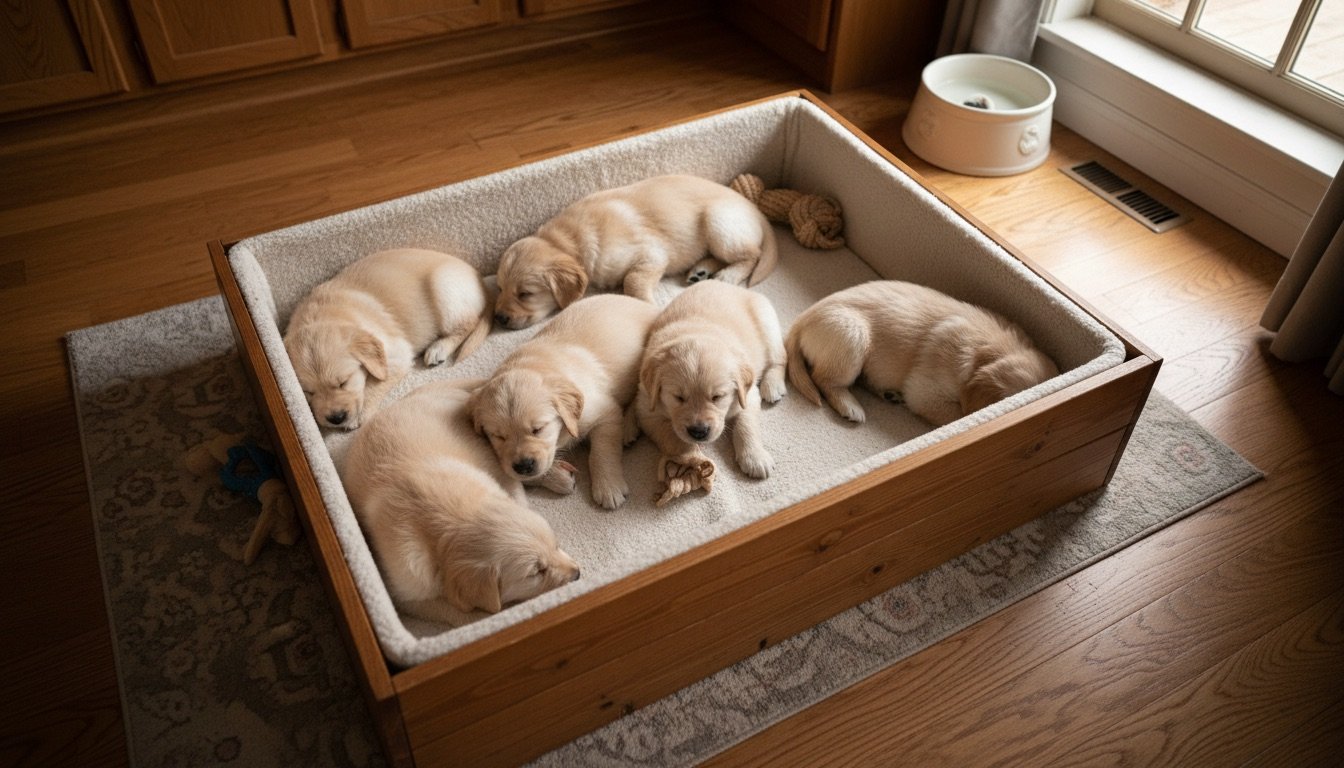
Almost everybody chooses wrong the first time, and almost everybody chooses wrong in the same direction: they take the puppy that comes to them first.
That puppy is the boldest in the litter. Bold is wonderful in a household with time, structure and previous experience of dogs. It is exhausting in a quiet house that wanted a gentle companion, and the mismatch shows up around month five, which is exactly when the puppy stops being small enough to be forgiven for it.
What actually varies within one litter
Puppies from the same parents, raised in the same room, still differ in three ways that are visible by six weeks.
How quickly they recover. Drop a set of keys behind a litter. Every puppy will startle. The interesting number is not who jumps least, it is how long each one takes to come back and investigate. Fast recovery is the single most useful trait in a family dog, and it is a better predictor of an easy adult than boldness is.
How much they want people. Some puppies orient towards whoever walks in. Others carry on with their siblings. Neither is a fault. A very people focused puppy is easy to train and harder to leave alone. A more independent one is the reverse.
How they handle being held. Pick a puppy up and turn it gently onto its back for a few seconds. Some settle. Some wriggle and then settle. Some fight the whole time. This is not a personality test and it does not predict dominance, whatever you have read, but it does tell you how much handling work the first month will involve.
What does not vary usefully
The biggest puppy is not the one that will be the biggest dog. Weight at seven weeks correlates poorly with adult size, and the runt of a litter routinely finishes larger than a sibling.
Coat colour tells you nothing about temperament. Nor does sex, to any degree worth planning around in this breed. Markings tell you nothing at all.
The visit
Go once, if you possibly can, and go without deciding.
Sit on the floor and do nothing for ten minutes. Do not call the puppies, do not clap, do not offer anything. Just let the litter get on with itself. Almost everything you need to see happens in that ten minutes, and almost nobody does it, because everybody arrives wanting to interact.
Watch who plays with whom. Watch who leaves the group and who never does. Watch what happens when the mother comes back in.
Then ask to see the mother in the same room as the litter. Watch her rather than the puppies. A relaxed, unbothered mother in a house she is comfortable in tells you more about the coming decade than any individual puppy does.
Questions worth asking, and the answers to listen for
Which of these would you keep? A breeder who has spent eight weeks with a litter has an opinion. One who says they are all lovely is either being polite or has not been paying attention.
Which of these is wrong for us? This is the more useful question, and the answer is the one that separates a breeder from a seller. Anybody willing to lose a sale by talking you out of a particular puppy is worth listening to about everything else.
What has this litter already met? You want specifics. A vacuum, a doorbell, a car, gravel, rain, visitors, being alone for ten minutes. A vague answer about socialisation is not an answer.
What is your return policy for the whole life of the dog? Not the first week. The whole life. The answer should be immediate and it should be in writing somewhere.
Let the breeder choose, and here is why
The most reliable method is also the one people resist most: describe your household honestly and let the person who has lived with the litter for eight weeks match a puppy to it.
Honestly means honestly. How long the dog is genuinely alone on a normal Tuesday, not on your best week. Who does the walk in February when it is raining. What happens when you go away. Whether anybody in the house is nervous of dogs. Whether you have ever trained one before.
Nobody is going to refuse you a puppy for saying the dog will be alone for four hours a day. They will use it to pick a different puppy, which is the entire point.
The thing nobody tells you
The choice matters less than the eight weeks before it and the eight months after it.
A well raised puppy from a settled mother, taken into a household that suits it and socialised properly through the first four months, turns out well across a wide range of starting temperaments. A puppy from a nervous mother raised in an outbuilding will struggle whichever one you pick.
What a good breeder does while you are choosing
Watch the breeder as closely as you watch the puppies. There are four behaviours that separate somebody raising dogs from somebody moving stock.
They ask you more questions than you ask them. About your week, your household, your previous dogs, what happens if your circumstances change. A visit that is entirely you asking and them answering is a sales meeting.
They volunteer a downside. Every litter has a puppy with a complication: one that is slower to come forward, one that will need more work, one that is not right for most households. A breeder who mentions it unprompted is a breeder telling you the truth about the others too.
They are relaxed about you leaving without deciding. Pressure to commit on the day, a deposit taken at the door, another family who is coming tomorrow: all of that is a technique rather than a coincidence.
They put things in writing. The date of birth, the price, what is included, what happens if you cannot keep the dog in five years. A breeder who will only say these things out loud is a breeder who can change them later.
So spend your energy on choosing the litter, not on choosing within it. The parents are the litter, and the puppies here are priced individually so you can compare like with like. By the time you are standing in the room deciding between two puppies, you have already made the decision that mattered.