Feeding is where new owners get the most contradictory advice and the loudest opinions. Most of it does not matter much. Two things matter a great deal, and they are not the ones the internet argues about.
The first fortnight: change nothing
Your puppy arrives eating a particular food. Keep feeding exactly that for at least two weeks, even if you think it is the wrong food and intend to change it.
A puppy that has just left its mother, its siblings and the only house it has known is already under more stress than it will experience again for years. Adding a diet change to that week produces loose stools, which produces worry, which produces a vet visit for something that was never a health problem.
Every puppy leaving here goes with enough of its current food for a fortnight, precisely so this is not a decision you have to make on day one.
Changing food, when you do
Over seven to ten days, never overnight.
- Days one to three: three quarters old food, one quarter new.
- Days four to six: half and half.
- Days seven to nine: one quarter old, three quarters new.
- Day ten: all new.
If the stools go loose, go back a step and hold there for a few days before moving on. Slower is always available and it costs you nothing.
The thing that actually matters for a large breed puppy
Not the brand. The growth rate.
A Golden Retriever puppy grown fast, on too much food, carrying extra weight through the months when the joints are forming, has a meaningfully higher risk of hip and elbow problems for the rest of its life. Grown steadily and kept lean, that risk drops.
This is the single most useful thing an owner controls, it is free, and it is the opposite of what instinct says, because a chubby puppy looks healthy and a lean one looks like you are being mean.
The practical test is your hands rather than a scale. Run your palms along the ribs. You should feel them easily under a thin layer, the way you feel the knuckles on the back of your hand. Looking down from above there should be a visible waist behind the ribs. From the side the belly should tuck up rather than run straight.
If you cannot feel the ribs, feed less. Ignore the guideline on the bag, which is a starting point calculated for an average dog that does not exist, and feed the dog in front of you.
How much and how often
At eight weeks, four meals a day. Three from about twelve weeks. Two from about six months, and two for life after that. Adult Goldens do better on two meals than one.
Use the bag as a starting figure and then adjust every fortnight based on the rib test. A growing puppy’s requirement changes constantly and no printed number can keep up with it.
Choosing a food, briefly
Pick a complete food formulated for large breed puppies, from a manufacturer that employs a qualified veterinary nutritionist and runs feeding trials. Those two criteria narrow the field faster than any ingredient list.
Large breed puppy formulations exist because the calcium and phosphorus levels are controlled for exactly the growth rate issue above. That is a real reason to choose one, unlike most of the marketing on the front of a bag.
The reading room links to veterinary nutrition resources that will teach you to interrogate a label properly. They are not selling you food, which is what makes them worth reading.
On raw and home cooked diets: both can be done well and both are very easy to do badly, and a growing large breed puppy is the worst possible animal to learn on. If you want to go that route, do it with a qualified veterinary nutritionist formulating the diet, and start once the dog is grown.
Practical things nobody mentions
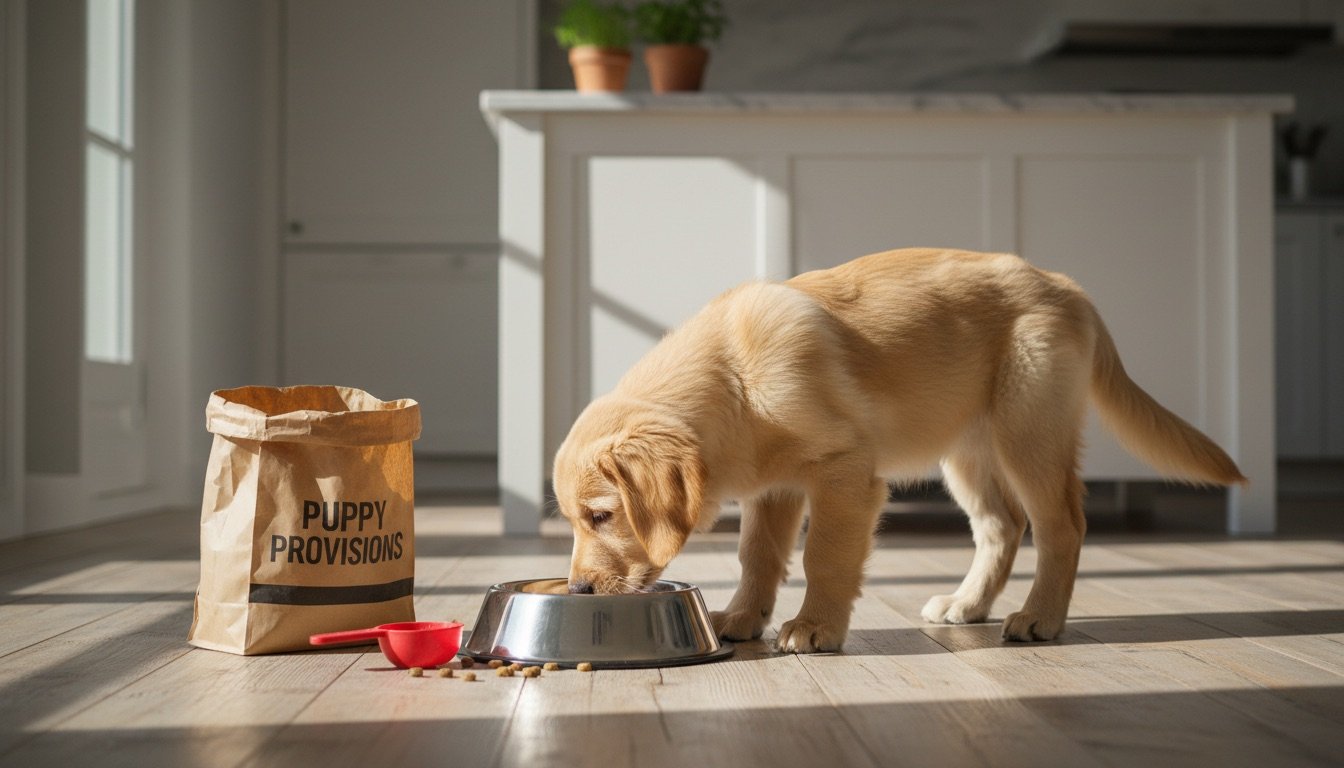
Feed in the crate. It makes the crate the best place in the house and it stops a puppy guarding a bowl in the middle of a busy kitchen.
Use some of the daily food for training. Measure the day’s ration into a tub in the morning and take training rewards from it. That is how you train all day without the dog gaining a pound.
A slow feeder bowl. Goldens inhale food. Slowing it down reduces the chance of a bloated, uncomfortable dog after a meal.
Do not exercise hard around a meal. Leave an hour either side.
Fresh water, always, everywhere. Restricting water overnight to help toilet training is not worth it. Take the puppy out more often instead.
When to worry
Loose stools for more than two days, any blood, repeated vomiting, refusing food for more than one meal, or a puppy that is quiet and flat rather than its usual self. Ring your vet. Puppies dehydrate quickly and it is always better to be the person who rang unnecessarily.
Treats, chews and the things that add up
Treats should be no more than a tenth of what a puppy eats in a day, and most people are well over that without realising, because treats are given by several members of a household who are each only giving a few.
The fix is the tub. Measure the day’s food out in the morning and make everyone take rewards from it. When the tub is empty, the day is done. It removes the argument entirely and it costs nothing.
On chews: a puppy needs something to chew and will find something if you do not provide it. Avoid anything harder than you would happily hit your own knee with, which rules out most bones, antlers and hard nylon, all of which fracture teeth. Supervise every chew and take away anything small enough to swallow.
Human food is not automatically dangerous, but several common things genuinely are. Grapes and raisins, onion and garlic, chocolate, anything sweetened with xylitol, and cooked bones of any kind. The reading room links to a poison control resource worth keeping a number for.
The one rule that covers most of it
Feed the dog in front of you rather than the number on the bag, keep it lean enough that you can feel the ribs, and change things slowly. Almost every feeding question people send us is answered by one of those three.
One skipped meal in an otherwise bright, playful puppy is usually nothing. A dull puppy that is off its food is not.